
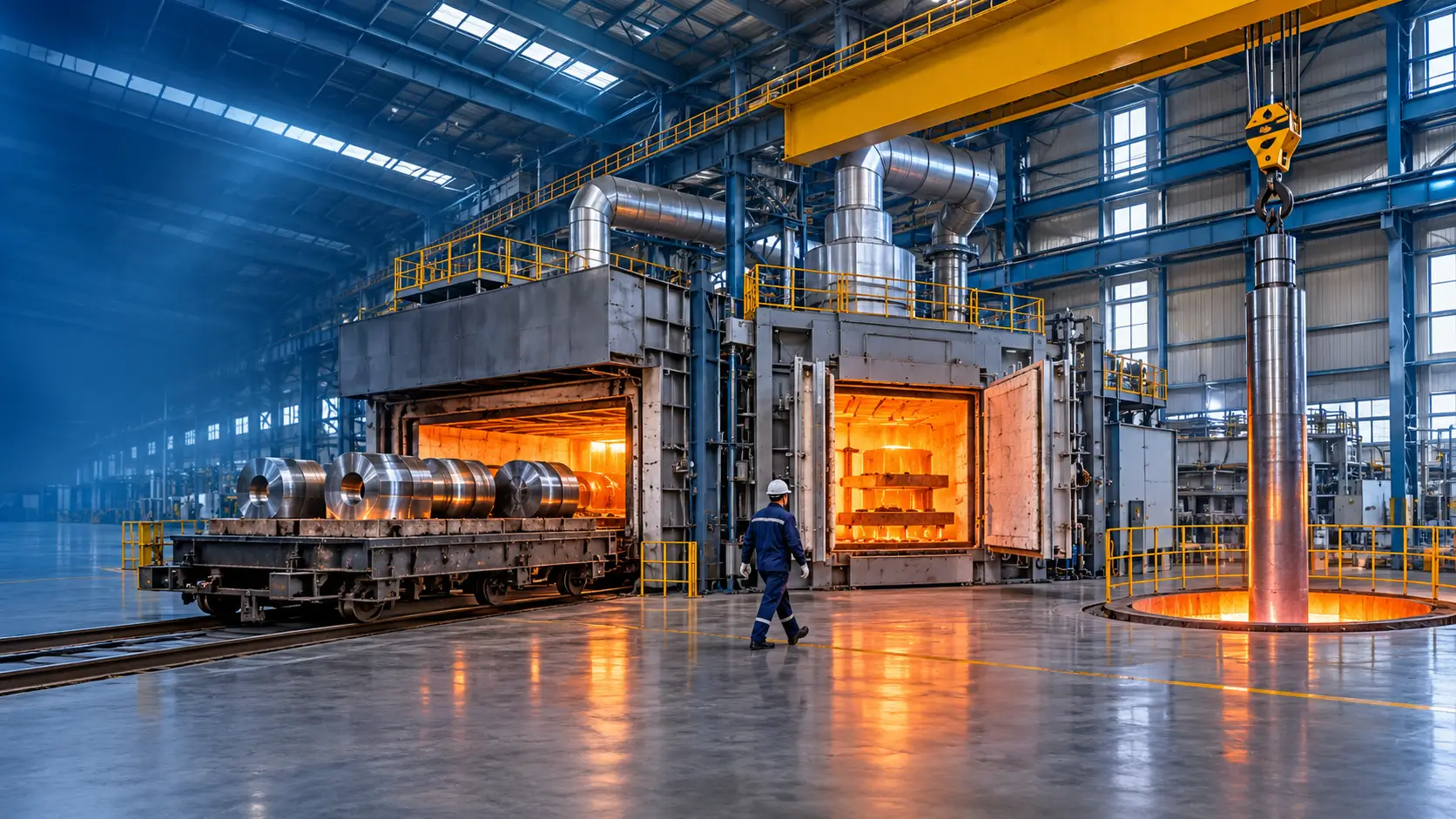
Short answer: The right heat treatment furnace is decided by four things: the process temperature, the size and shape of the part, how quickly it must be quenched, and how many parts you run. In practice, bogie hearth furnaces suit heavy forgings and castings, pit furnaces suit long shafts, box and fixed hearth furnaces suit mixed batch work, furnaces with a recirculation fan suit tempering, stress relieving and ageing, and continuous pusher or mesh belt furnaces suit high-volume parts.
Every heat treatment follows the same pattern — heat, soak, cool — but each heat treatment process asks something different of the furnace. This guide matches the common processes to the furnace types built for them, so you can shortlist the right design before you ask for a quote.
Four questions that decide the furnace
1. What temperature does the process need?
Above roughly 700 °C, radiation from the walls and heating elements does most of the work, and a radiant furnace heats evenly. Radiant heat transfer rises with the fourth power of absolute temperature, so it falls away quickly as temperature drops. Below that range a recirculation (RC) fan is needed to drive hot gas through the load; without it, a tempering or ageing load heats slowly and unevenly.
2. What does the part look like?
Heavy, bulky parts of several tonnes need a hearth that comes out to the crane — a bogie hearth. Long shafts, tubes and rolls distort less when hung or stood vertically in a pit furnace. Mixed small and medium parts fit a box or fixed hearth furnace, and small loose parts in large quantities suit a mesh belt.
3. Does the part need quenching?
For hardening, the time between opening the door and the part entering the quench affects the result. Quench tank position, door design and handling equipment such as a manipulator become part of the furnace choice.
4. How many parts, how often?
Varied jobs and changing cycles favour batch furnaces; steady high volumes of one part family favour continuous lines. Our guide to batch vs continuous heat treatment furnaces covers this decision in detail. Fuel choice and energy cost come next — see how to reduce furnace fuel consumption.
Which furnace for which process
| Process | Typical temperature* | What the furnace must do well | Usual furnace types |
|---|---|---|---|
| Hardening | 800–1,000 °C | Uniform soak; fast, repeatable transfer to quench | Fixed hearth, bogie hearth, pit; pusher for high volume; quench tank and manipulator for heavy parts |
| Tempering | 150–700 °C | Tight uniformity at low temperature | Box, bogie or pit furnace with RC fan; mesh belt for small parts |
| Annealing | 650–950 °C (by type) | Long soak and slow, controlled furnace cooling | Bogie hearth, box, pit; bell for bright annealing under protective atmosphere; pusher for isothermal annealing |
| Normalising | 850–950 °C | Even heating, then cooling in still air | Bogie hearth, fixed hearth, pit, pusher |
| Stress relieving | 550–650 °C | Slow, even heating and cooling of large fabrications | Bogie hearth or pit, ideally with RC fan |
| Solution treatment and ageing (aluminium) | ≈500–540 °C / ≈120–200 °C | Very tight uniformity; rapid quench after solution treatment | Box or pit furnace with RC fan |
| Solution annealing (stainless steel) | 1,000–1,120 °C | High temperature and rapid cooling | Fixed hearth, bogie hearth |
| Case hardening (carburising, nitriding) | 500–950 °C | Controlled furnace atmosphere | Sealed-quench, pit carburising or nitriding furnaces |
*Typical ranges for carbon and alloy steels unless noted. The material grade and customer specification always decide the actual cycle.
The main furnace types explained
Bogie hearth furnace
A bogie hearth furnace has a hearth on a rail-mounted car that rolls out for crane loading. It is the standard choice for large forgings, castings and weldments in hardening, normalising, annealing and stress relieving. Our projects include gas-fired bogie hearth furnaces of 35 MT and 50 MT capacity and electric versions up to 1,100 °C.
Fixed hearth furnace
A fixed hearth furnace has a stationary hearth loaded by forklift or charger. It is a flexible workhorse for mixed batch work — hardening, normalising, annealing and solution annealing — where parts are not heavy enough to need a bogie.
Box, bell and pit furnaces
Box and bell type furnaces cover general batch work, with the bell configuration lowering a heated cover over the load for controlled heating under protective atmosphere. A pit type furnace is set into the floor and loaded from above, ideal for long shafts, tubes and heavy cylindrical parts.
Furnaces with a recirculation (RC) fan
Convection designs such as the fixed box furnace with RC fan, bogie furnace with RC fan and pit type furnace with RC fan are built for tempering, stress relieving and ageing. Forced circulation shortens heat-up and makes tight uniformity achievable at low temperatures — which matters when the furnace must pass a temperature uniformity survey.
Continuous furnaces
For steady production, parts move through heating zones on trays, belts or trolleys. A pusher furnace handles hardening, normalising and isothermal annealing at volume; a mesh belt furnace suits small parts for tempering and ageing; trolley and slat conveyor furnaces handle medium to large components and low-temperature thermal conditioning.
Ladle preheaters
Not a heat treatment furnace for parts, but common in the same plants: a ladle preheater heats foundry ladles before pouring to cut thermal shock and heat loss from the molten metal.
Pairing furnaces in a hardening and tempering line
Almost every hardened part is tempered, so hardening and tempering furnaces are usually planned together. The common arrangement is a high-temperature radiant furnace for hardening, a quench tank close to the door, and a separate RC-fan furnace for tempering. Using one furnace for both forces a compromise: a radiant chamber built for 900 °C struggles to hold uniformity at 200–400 °C, and switching cycles costs time and fuel. Mass Engrs has supplied matched hardening and tempering sets from 1.2 MT to 50 MT, including lines with manipulators for heavy parts.
Common selection mistakes
- Choosing on maximum temperature alone. A furnace rated for 1,100 °C is not automatically good at 250 °C.
- Sizing for today’s largest part. Add margin for the next order; the qualified work zone limits what you can process.
- Ignoring the quench. Transfer time and quench capacity affect hardness as much as the furnace does.
- Leaving the standard out of the enquiry. If parts must meet AMS2750 or CQI-9, the furnace class and instrumentation type must be specified at the start.
What to send for a furnace quote
- Processes and temperatures, with material grades
- Largest part dimensions and weight, and load per batch
- Daily or monthly throughput and working shifts
- Quench medium, if any, and handling method
- Fuel or power available on site
- Applicable standard and furnace class, if any
Frequently asked questions
What are the main types of heat treatment furnaces?
The main types are batch furnaces — bogie hearth, fixed hearth, box, bell and pit — and continuous furnaces such as pusher, mesh belt, trolley and slat conveyor designs. Either group can be radiant or fitted with a recirculation fan for convection heating, and can be electric, gas-fired, oil-fired or dual-fuel.
Which furnace is best for hardening and tempering?
Hardening needs a high-temperature furnace with a fast, controlled transfer to the quench, such as a fixed hearth, bogie hearth or pit furnace with a quench tank, or a pusher furnace for high volumes. Tempering is best done in a separate furnace with a recirculation fan, because forced convection gives far better uniformity at tempering temperatures.
Why do tempering furnaces need a recirculation fan?
Radiant heat transfer falls sharply as temperature drops, so below roughly 700 °C a radiant furnace heats the load unevenly. A recirculation fan drives hot gas through the load, giving faster heating and tighter uniformity for tempering, stress relieving and ageing.
What is the difference between a bogie hearth and a pit furnace?
A bogie hearth furnace has a movable car that rolls out for loading, which suits heavy and bulky forgings, castings and fabrications. A pit furnace is loaded vertically from the top, which suits long shafts, tubes and rolls that can hang or stand upright with less distortion.
Can one furnace do annealing, normalising and hardening?
Yes, a well-designed radiant batch furnace can cover annealing, normalising and hardening because they share a similar temperature range. Low-temperature processes such as tempering and ageing are usually better in a separate convection furnace.
Should a heat treatment furnace be electric or gas-fired?
It depends on power and fuel tariffs, supply reliability, process temperature and cleanliness requirements. Electric furnaces offer clean, precise heating; gas and oil furnaces suit heavy-duty, high-temperature work; dual-fuel designs help plants manage changing fuel prices.
Talk to Mass Engrs
Tell us the process, material, largest part and daily throughput, and our engineers will recommend the furnace type and configuration. Call 0233-2990599, email sales@mass-engrs.com, or use our contact page.
References
- ASM International, ASM Handbook Volume 4A: Steel Heat Treating Fundamentals and Processes (2013)
- SAE AMS2750H — Pyrometry (SAE International, revised July 2024)
- Bureau of Energy Efficiency — Energy conservation guidelines for industries