
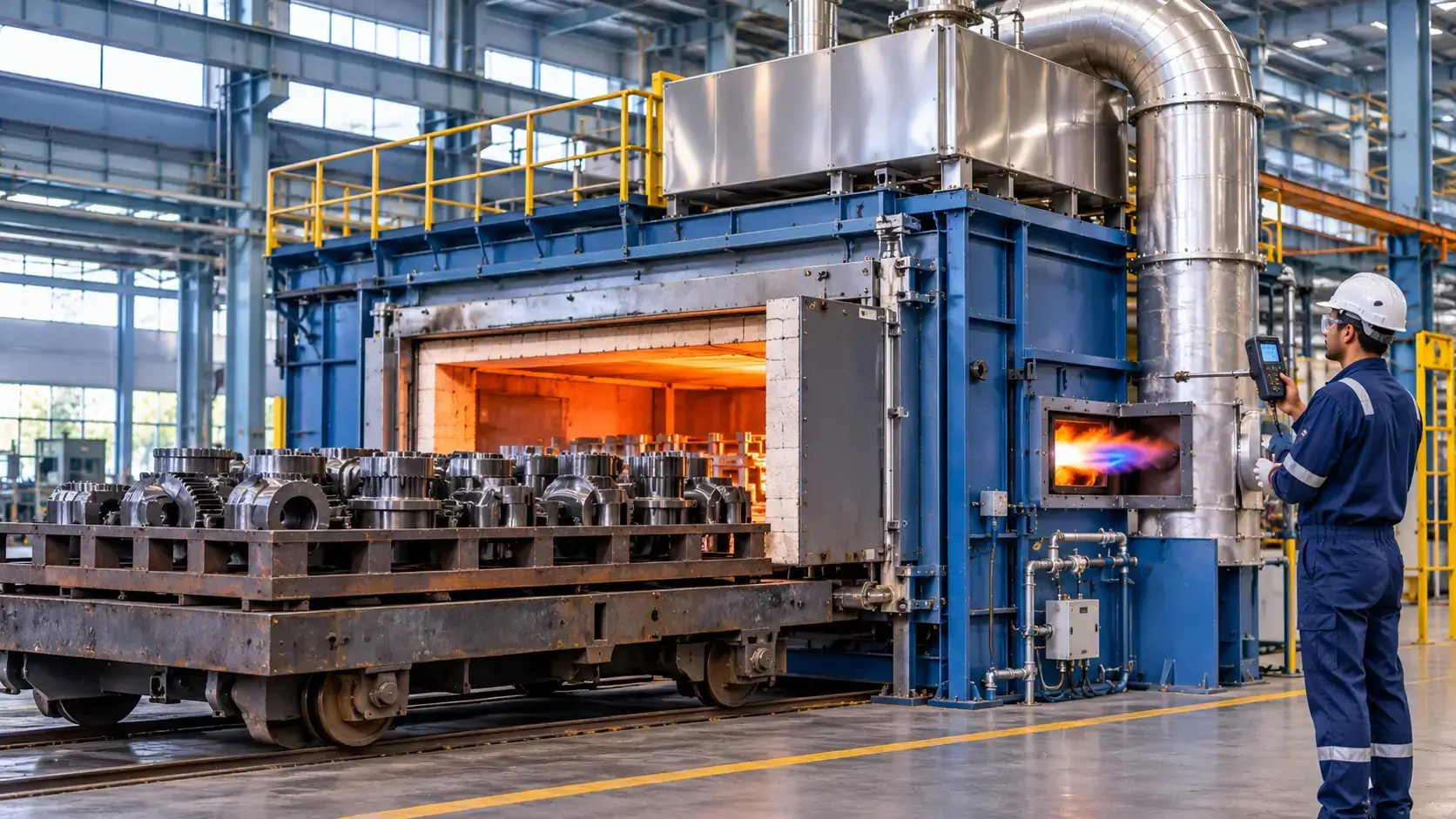
Short answer: To reduce furnace fuel consumption, first measure fuel per tonne, then fix the cheap losses — excess combustion air, leaking doors and part-empty loads. The bigger savings come from preheating combustion air with a recuperator, relining with low-thermal-mass ceramic fibre and upgrading burners and controls. Most of this can be done on the furnace you already own.
Fuel is usually the largest running cost of a heat treatment shop after labour, and much of it does no useful work. This guide shows where the heat goes, the nine fixes that recover it, and how to decide between upgrading and replacing.
Start with one number: fuel per tonne
You cannot manage what you do not measure. Before changing anything, log fuel (SCM of gas, litres of oil or kWh of electricity) and the tonnage processed for every batch over two to four weeks. Divide one by the other to get specific energy consumption per tonne. Record idle and holding hours separately — many furnaces burn a surprising share of their fuel with nothing inside. This baseline is what every later improvement is measured against.
Where the heat goes
| Loss | What it looks like | Main fix |
|---|---|---|
| Flue gas | Hot exhaust carrying unused heat; often the largest loss in fuel-fired furnaces | Excess air control, recuperator |
| Stored heat | Heavy brick linings reheated every batch cycle | Ceramic fibre relining |
| Wall and roof | Hot shell, degraded insulation | Reline, repair hot spots |
| Openings and leaks | Flame or glow at doors, cold air drawn in | Seals, pressure control, door discipline |
| Idle time | Furnace held hot between loads | Scheduling, setback temperature |
| Unnecessary soak | Cycles longer than the metallurgy requires | Load thermocouples, cycle review |
Nine practical fixes
1. Control excess air
Burners need some excess air for complete combustion, but every extra cubic metre of air is heated to flue temperature and thrown away. Measure flue oxygen and CO, set the fuel-to-air ratio across the firing range, and add oxygen trim on larger furnaces. The Bureau of Energy Efficiency lists monitoring O₂, CO₂ and CO and holding excess air at the optimum as a core furnace measure. Cost: low.
2. Seal doors and openings
A furnace under negative pressure pulls cold air through every gap. Repair door seals and sight ports, keep the chamber under slight positive pressure, and minimise door-open time during charging. Cost: low.
3. Load to capacity
A furnace uses almost as much fuel to heat itself half-empty as full. Plan batches to fill the qualified work zone, and cut fixture weight — every kilogram of basket is heated and cooled each cycle without being sold. Matching load to furnace capacity is one of BEE’s standard recommendations. Cost: nil.
4. Cut idle hot time
Group work so the furnace runs back-to-back instead of holding temperature between shifts. Where waits are unavoidable, drop to a setback temperature rather than full process temperature. Cost: nil to low.
5. Review soak times
Many cycles carry extra soak “to be safe”. Load thermocouples show when the part centre actually reaches temperature, so soak can be set from evidence — always within the limits of the material and customer specification. Cost: low.
6. Preheat combustion air with a recuperator
A recuperator on the flue transfers exhaust heat to the incoming combustion air. US Department of Energy guidance shows savings rising with flue gas temperature, and identifies processes above about 870 °C (1,600 °F) as good candidates (NREL tip sheet). In one documented heat treating case, preheating air to about 280 °C on a furnace with flue gas near 450 °C cut fuel use by roughly 13% (ORNL training material). Cost: medium to high; best for long running hours.
7. Reline with ceramic fibre
Dense brick stores a large amount of heat that is lost every time a batch furnace cools. BEE recommends ceramic fibre for batch operations. Low-thermal-mass fibre linings heat up faster and cut stored-heat and standby losses; fibre modules can often be fitted over sound existing brick as a hot-face upgrade. Cost: medium.
8. Upgrade burners and controls
Modern high-velocity burners improve circulation and heat transfer; ratio control keeps combustion efficient at low fire; multi-zone PID or SCR control removes overshoot. On electric furnaces, failed or aged elements and poor power control waste energy and spoil uniformity. PLC/SCADA logging also gives you the fuel-per-tonne data automatically. Cost: medium.
9. Reuse waste heat elsewhere
Exhaust that cannot go back to the burners can still preheat the next charge, a parts washer or a drying oven. BEE lists waste heat recovery as a standard furnace measure in its energy conservation guidelines. Cost: medium; depends on plant layout.
An illustrative payback example
Assume a gas-fired bogie hearth furnace spends ₹60 lakh a year on fuel. Combustion tuning and sealing save 5%, and a recuperator saves a further 12% of what remains. Savings compound rather than add: 1 − (0.95 × 0.88) ≈ 16%, or about ₹9.8 lakh a year. If the work costs ₹15–20 lakh, simple payback is under two years. These figures are illustrative only — real savings depend on your furnace, temperature, fuel and running hours, which is why the baseline measurement comes first.
Modernise or replace?
| Situation | Better route |
|---|---|
| Shell, structure and hearth are sound; controls or burners are outdated | Modernise |
| Energy use high but capacity still matches production | Modernise |
| Furnace fails its uniformity class repeatedly due to design limits | Modernise if fixable, otherwise replace |
| Production has outgrown the furnace or the process has changed | Replace |
| Steady high-volume work on one part family | Consider continuous — see batch vs continuous guide |
Our modernisation of existing furnaces service upgrades furnaces of any make — controls, burners, elements and insulation — at a fraction of new-furnace cost. If replacement makes more sense, start with batch vs continuous heat treatment furnaces and browse our furnace range, including bogie hearth and fixed hearth designs. Our R&D team uses thermal modelling to compare fuel-fired and electric heating for each application.
Do not trade energy for quality
Every change to burners, lining, fans or controls can shift temperature uniformity. If your furnace is qualified under AMS2750 or CQI-9, plan a fresh temperature uniformity survey before it returns to production — and use it to confirm the upgrade improved uniformity, not just the fuel bill.
Frequently asked questions
How much fuel can an existing heat treatment furnace save?
It depends on the furnace’s starting condition and temperature. Combustion tuning, sealing and better loading often give savings in single digits each, while combustion air preheating can deliver double-digit savings on high-temperature furnaces. Measure fuel per tonne before and after each change to know the real figure.
What is the quickest way to reduce furnace fuel consumption?
Check the flue gas oxygen and set the burners to the correct fuel-to-air ratio, then seal door and opening leaks and keep the furnace at slight positive pressure. These steps need little capital and show results within days.
What is a recuperator on a furnace?
A recuperator is a heat exchanger on the furnace flue that uses hot exhaust gas to preheat the combustion air going to the burners. Because the air arrives hot, less fuel is needed to reach the same furnace temperature. It pays back best on furnaces running at high temperatures for long hours.
Is ceramic fibre lining suitable for every furnace?
Ceramic fibre suits batch furnaces well because it stores far less heat than dense brick, so less fuel is spent heating the furnace each cycle. Areas exposed to mechanical impact, heavy scale or direct load contact, such as hearths, usually stay in dense refractory.
Should we switch from oil to gas or to electric heating?
There is no single answer: it depends on local fuel and power tariffs, supply reliability and the process. Mass Engrs evaluates electric, gas, oil and dual-fuel options for each application, and dual-fuel systems can help plants manage fluctuating energy prices.
Will energy upgrades affect AMS2750 or CQI-9 qualification?
Any change that can affect uniformity — burners, elements, lining, fans or controls — requires a fresh temperature uniformity survey before the furnace returns to qualified production. Plan the survey into the upgrade schedule.
Talk to Mass Engrs
Send us your furnace type, fuel, operating temperature and monthly fuel bill, and our engineers will suggest where the savings are. Call 0233-2990599, email sales@mass-engrs.com, or use our contact page.